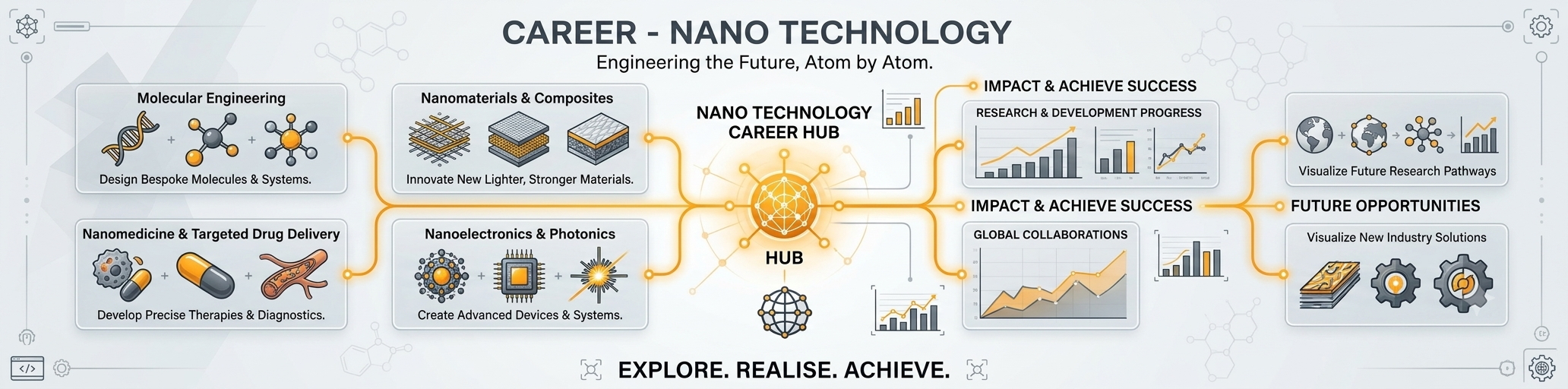
Careers in Nano Technology
Unlocking the Future, One Atom at a Time.
Introduction
Embark on a fascinating journey into the realm of nanotechnology, a rapidly evolving field at the intersection of science and engineering. Nanotechnology involves the understanding, manipulation, and application of materials at the nanoscale – typically between 1 and 100 nanometers. Professionals in this field work with incredibly small structures to create new materials, devices, and systems with unique properties and functionalities. If you possess a keen interest in science, a knack for problem-solving, and a desire to push the boundaries of innovation, a career in nanotechnology could be your gateway to shaping the future.
What is Nanotechnology and Why is it Important?
Nanotechnology is the science, engineering, and technology conducted at the nanoscale, which is about 1 to 100 nanometers. At this scale, materials exhibit unique physical, chemical, and biological properties that differ significantly from their bulk counterparts. This field is interdisciplinary, drawing from physics, chemistry, biology, materials science, and engineering, to develop revolutionary products and applications.
Becoming a nanotechnology professional typically requires a strong foundation in science and mathematics, followed by specialized education. This includes pursuing relevant undergraduate degrees, followed by master's or doctoral programs focusing on nanoscience, nanotechnology, or related engineering disciplines. Practical experience through internships, research projects, and hands-on lab work is crucial for developing essential skills and understanding.
The career path in nanotechnology is diverse and can lead to roles in research and development, materials science, engineering, manufacturing, and academia. Entry-level positions often involve research assistance or technical roles. With experience and advanced degrees, individuals can progress to lead research projects, manage R&D teams, develop new technologies, or pursue academic careers in teaching and research.
While nanotechnology shares common ground with fields like materials science, physics, and chemistry, its unique focus on atomic and molecular manipulation sets it apart. Unlike traditional materials science that might study properties at the macro or micro level, nanotechnology delves into the quantum realm, unlocking properties and applications not possible at larger scales. It's an enabling technology that enhances and transforms existing fields, driving innovation across a vast spectrum.
Building Your Foundation in Nanotechnology
A robust understanding of fundamental scientific principles is paramount. This includes a deep grasp of quantum mechanics, solid-state physics, chemistry (especially organic, inorganic, and physical chemistry), materials science, and advanced mathematics. Familiarity with microscopy techniques, fabrication methods, and data analysis is also critical.
Key subjects include Quantum Mechanics, Solid State Physics, Surface Chemistry, Materials Science, Nanoscale Engineering, Nanofabrication, Spectroscopy, Thermodynamics, and Advanced Calculus. Specialized courses in areas like nanoelectronics, nanomedicine, or nanomaterials are also highly beneficial.
While not always a direct path to senior roles, diploma and certification courses can offer specialized skills or introductory knowledge. These may cover topics like Nanomaterial Synthesis, Nanofabrication Techniques, or specific characterization methods. They can be valuable for upskilling or for those transitioning from related fields.
A bachelor's degree in a related science or engineering field is typically the starting point. Common undergraduate majors include Physics, Chemistry, Materials Science and Engineering, Electrical Engineering, Mechanical Engineering, or Chemical Engineering. Some universities now offer specialized undergraduate degrees in Nanoscience or Nanotechnology.
A Master's degree in Nanotechnology, Nanoscience, or a specialized engineering field (like Nanomaterials, Nanoelectronics, or Nanomedicine) provides deeper theoretical knowledge and practical research experience. This level of education is often required for R&D positions and advanced technical roles.
A Ph.D. is essential for those aspiring to lead independent research, work in cutting-edge R&D, or pursue academic careers. Doctoral programs involve extensive research, often culminating in the development of novel materials, devices, or theoretical models at the nanoscale. Specializations can range widely, from quantum dots to nanorobotics.
Gaining Admission to Nanotechnology Programs
Admission to undergraduate and graduate programs in nanotechnology and related fields often requires successful performance on standardized entrance exams. For undergraduate studies in India, these might include JEE Main/Advanced for engineering colleges. For postgraduate studies, exams like GATE (Graduate Aptitude Test in Engineering) in relevant disciplines (Physics, Chemistry, Materials, Electrical, Mechanical) are crucial. Internationally, GRE (Graduate Record Examinations) and TOEFL/IELTS (for English proficiency) are commonly required.
Where to Study Nanotechnology
Renowned universities worldwide offer leading programs in nanotechnology and nanoscience. These include institutions in the USA (e.g., MIT, Stanford, UC Berkeley), Europe (e.g., ETH Zurich, University of Cambridge, Delft University of Technology), and Asia (e.g., National University of Singapore, University of Tokyo). These institutions boast state-of-the-art research facilities and leading faculty.
India has a growing number of institutions offering specialized programs in nanotechnology. Prominent institutes include the Indian Institute of Technology (IITs) Bombay, Delhi, Madras, Kanpur, and Kharagpur; the Indian Institute of Science (IISc) Bangalore; the National Institute of Science Education and Research (NISER) Bhubaneswar; and various universities with dedicated nanoscience and nanotechnology departments or centers.
Essential Skills for Nanotechnology Professionals
Success in nanotechnology requires a blend of technical and soft skills. Key technical skills include expertise in quantum mechanics, materials science, chemistry, physics, nanofabrication techniques, microscopy (SEM, TEM, AFM), spectroscopy, and data analysis. Strong problem-solving abilities, critical thinking, attention to detail, and research methodology are also vital. Soft skills like communication, teamwork, and project management are equally important for collaboration and advancement.
Personal Traits That Drive Nanotechnology Success
Individuals thriving in nanotechnology often possess an innate curiosity, a passion for discovery, and a strong drive for innovation. A high degree of patience and persistence is necessary, as nanoscale research can be meticulous and time-consuming. An analytical mindset, meticulousness, and a commitment to precision are also crucial attributes for working with such small-scale phenomena and intricate processes.
Who is Suited for a Career in Nanotechnology?
The ideal personality for a nanotechnology career is inquisitive, detail-oriented, and enjoys complex problem-solving. Individuals who are comfortable working with abstract concepts, are persistent in the face of challenges, and possess a natural inclination towards scientific exploration and innovation tend to excel. A collaborative spirit is also beneficial, as many projects involve interdisciplinary teams.
Exploring Career Opportunities in Nanotechnology
Nanotechnology careers span research, development, engineering, and manufacturing across various sectors. Roles include Nanomaterials Scientist, Research Scientist, Nanofabrication Engineer, Process Engineer, R&D Manager, Product Development Engineer, Quality Control Specialist, and Technical Consultant. Opportunities exist in both academic institutions and private industry.
Internships are invaluable for students and early-career professionals in nanotechnology. They provide hands-on experience in research labs, manufacturing facilities, or R&D departments. Internships allow you to apply theoretical knowledge, learn specific techniques, build professional networks, and gain insights into different career paths within the field.
Part-time job opportunities in nanotechnology might be available for students or individuals seeking to gain experience while pursuing education or other commitments. These could involve assisting in research projects, data analysis, lab support, or technical writing. Such roles offer flexibility and exposure to the industry.
Freelancing in nanotechnology is less common for hands-on lab work but can be prominent in areas like technical writing, consulting, patent analysis, literature reviews, scientific editing, or software development for simulation and analysis. Experts may offer their services on a project basis to companies or research groups.
Nanotechnology's applications are vast, impacting numerous industries including electronics (smaller, faster chips), medicine (drug delivery, diagnostics), materials science (stronger, lighter materials), energy (efficient solar cells, batteries), environmental science (water purification, sensors), textiles (smart fabrics), and aerospace.
Sample job titles include: Nanotechnology Researcher, Materials Scientist (Nanomaterials), Micro/Nano Engineer, Process Development Engineer, R&D Scientist (Nanotechnology), Senior Nanofabrication Technician, Applications Engineer (Nano), Nanomedicine Scientist, Quantum Dot Developer, and Nanocomposites Specialist.
Finding jobs involves leveraging academic career services, attending industry conferences and job fairs, networking with professionals and researchers, and utilizing online job boards specializing in science and engineering. Tailoring your resume and cover letter to highlight relevant skills and research experience is crucial. For research roles, direct outreach to PIs (Principal Investigators) at universities or R&D managers in companies can also be effective.
The nanotechnology sector is projected for significant growth, driven by ongoing research and the development of new applications. As technologies mature and become more integrated into consumer products and industrial processes, the demand for skilled nanotechnology professionals is expected to rise substantially across various sectors, indicating a promising career outlook.
Understanding Nanotechnology Compensation
Salaries in nanotechnology vary widely based on education level, experience, specialization, location, and the sector (academia vs. industry). Entry-level positions with a Bachelor's degree might start between $50,000 - $70,000 annually. With a Master's degree or Ph.D. and several years of experience, salaries can range from $80,000 to $150,000+, with senior research scientists or R&D managers potentially earning significantly more. Specialized roles in high-demand industries often command higher compensation.
Innovating and Leading in Nanotechnology
Entrepreneurship in nanotechnology involves identifying a novel application or technology and developing it into a commercial product or service. This path requires not only scientific and technical expertise but also business acumen, market understanding, fundraising capabilities, and the ability to build and lead a team. Many startups emerge from university research or focus on niche markets with high growth potential.
Choosing between entrepreneurship and a traditional job in nanotechnology depends on individual risk tolerance, ambition, and personal goals. Entrepreneurship offers the potential for high rewards and greater autonomy but comes with significant risk, long hours, and immense responsibility. Joining an established company or research institution provides stability, structured career progression, and access to resources, but with less control over direction.
The Role of Experience in Nanotechnology Careers
Gaining practical experience is critical in nanotechnology. This includes hands-on laboratory work, research projects during academic studies, internships, co-op programs, and post-doctoral research. Experience in specific fabrication techniques, characterization methods, data analysis, and project management are highly valued by employers.
The relationship between college work and industry requires understanding how academic research translates into practical applications. Students should seek opportunities that bridge this gap, such as research focused on industry problems, internships with companies, or collaborations between universities and businesses. Developing marketable skills and staying updated on industry trends is key.
Continuous learning and training are vital in the fast-paced field of nanotechnology. This includes attending workshops, short courses on new techniques or equipment, specialized training programs offered by equipment manufacturers, and staying abreast of scientific literature. Professional development ensures that skills remain current and relevant.
Thriving in the Nanotechnology Ecosystem
Pros: Working at the cutting edge of science and technology, potential for groundbreaking discoveries, high demand for skilled professionals, diverse applications across industries, and intellectually stimulating work. Cons: Requires extensive education and specialized training, research can be slow and meticulous, ethical considerations regarding new technologies, potential for high competition, and the need for continuous learning due to rapid advancements.
Your Ikigai in nanotechnology lies at the intersection of what you love (scientific inquiry, innovation), what you are good at (analytical thinking, problem-solving), what the world needs (new materials, medical solutions, sustainable technologies), and what you can be paid for (research, engineering, development). Finding this sweet spot leads to fulfilling and sustainable career satisfaction.
Work-life balance in nanotechnology can vary. Research-intensive roles, especially during critical project phases or academic pursuits like Ph.D.s, may require long hours. However, many industry positions offer more predictable schedules. Planning, efficient time management, and setting boundaries are key to maintaining a healthy balance, especially with the intellectual demands of the field.
The demanding nature of research and development in nanotechnology can impact mental health. Challenges like project setbacks, intense competition, and long hours necessitate proactive well-being strategies. Prioritizing self-care, seeking support from colleagues and mentors, maintaining hobbies, and practicing mindfulness can help mitigate stress and promote mental resilience.
A high emotional quotient (EQ) is crucial in nanotechnology for effective collaboration, leadership, and navigating complex team dynamics. Understanding and managing your own emotions, empathizing with colleagues, and communicating effectively are vital for building strong professional relationships, resolving conflicts, and fostering a positive work environment, especially in interdisciplinary teams.
A high intelligence quotient (IQ) is foundational for grasping the complex theoretical concepts in quantum mechanics, physics, and chemistry that underpin nanotechnology. Strong analytical, logical reasoning, and problem-solving skills are essential for designing experiments, interpreting data, and innovating at the nanoscale. Continuous intellectual curiosity drives advancement in this field.
The working environment for nanotechnology professionals typically involves research laboratories equipped with advanced instrumentation (electron microscopes, fabrication tools, spectroscopy equipment) or cleanroom facilities for precise manufacturing. Other settings include R&D offices, university labs, or industrial production sites. Collaboration with diverse teams of scientists and engineers is common.
Essential Tools and Resources for Nanotechnology
Essential tools include advanced microscopy (Scanning Electron Microscopes - SEM, Transmission Electron Microscopes - TEM, Atomic Force Microscopes - AFM), spectroscopy equipment (XPS, EDS), nanofabrication tools (lithography systems, deposition tools), and characterization instruments. Software for simulations (e.g., COMSOL, VASP), data analysis (e.g., Origin, MATLAB), and molecular modeling is also vital.
While formal licensing isn't as common as in fields like civil engineering, specialized certifications in areas like cleanroom operations, specific analytical equipment usage, or project management (e.g., PMP) can enhance employability. Some companies may have internal certification processes for handling specialized equipment or processes.
Joining professional associations provides access to the latest research, networking opportunities, conferences, and professional development. Key organizations include the Materials Research Society (MRS), The Optical Society (OSA), IEEE Nanotechnology Council, American Vacuum Society (AVS), and national nanoscience/nanotechnology societies. These associations foster collaboration and knowledge sharing.
Your Questions About Nanotechnology Careers Answered
Q1: Is nanotechnology a good career choice? A: Yes, it's a rapidly growing field with significant innovation and demand. Q2: What is the minimum education required? A: A Bachelor's degree in a related science or engineering field is usually the minimum, with Master's or Ph.D. often preferred for R&D roles. Q3: What are the biggest challenges in nanotechnology? A: Scaling up lab discoveries to industrial production, cost-effectiveness, and addressing potential health/environmental impacts are significant challenges. Q4: Can I work in medicine with a nanotechnology background? A: Absolutely; nanomedicine is a major subfield involving drug delivery, diagnostics, and regenerative medicine.
Advice for Aspiring Nanotechnology Professionals
Build a strong academic foundation in STEM subjects. Seek out research opportunities and internships early in your education. Network actively with professors, researchers, and industry professionals. Stay curious and continuously learn about new advancements. Develop strong problem-solving and critical thinking skills. Be open to interdisciplinary collaboration. Consider specializing in a niche area that interests you.
Key Takeaways for a Nanotechnology Career
A career in nanotechnology offers the chance to work at the forefront of scientific innovation, manipulating matter at the atomic and molecular level to create transformative products and solutions. It demands a robust educational background, strong analytical skills, and a persistent, curious mindset. Opportunities span research, engineering, and development across diverse industries, with a promising outlook for growth. By building a solid foundation, gaining practical experience, and continuously learning, you can forge a rewarding and impactful career in this exciting, ever-evolving field.