Archaeologist
All About How To Become An Archaeologist
Introduction
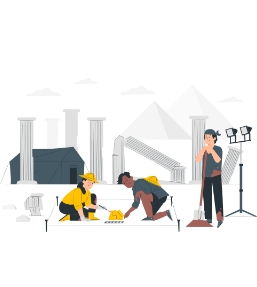
Archaeologists gather information about our past history by collecting evidence left behind by earlier civilizations. The evidence could be in the form of ruins, artefacts, pottery, cave paintings, sculptures, tools etc. Another facet of an archaeologist is that he has to ensure that the historical preservation/conservation laws are complied, in and around archaeological sites.
Archaeology is a subfield of anthropology. It exposes students to reconstruct extinct cultures from the artefacts as it studies the ancient and recent human past through material remains.
In case you are looking for a job in this career please note the process to apply for job
Get assistance through AI Matching for your Job Application Process on our partner platform - Jobs Matcher AI!
Please follow these easy steps:
Step 1: Register and Complete Your Profile on https://jobsmatcherai.com/signup
Step 2: Upload Your CV and Utilise AI / import profile data from your CV (PDF) or pasted text.
Step 3: Explore AI-Matched Opportunities - see AI job suggestions directly on your profile page based on these employer matches.
Step 4: Generate Your ATS-Friendly CV Preview
Step 5: Complete a Comprehensive SWOT Analysis
We look forward to your participation and happy placement!
For any other information / guidance on jobs or to meet a counsellor contact careers@eduberance.com Explore Realise and Achieve Your True Potential
Let's dive back to the career details
What is Archaeology All About?
Archaeologists study human history and prehistory by excavating sites and analyzing artifacts. They piece together the past by interpreting the physical remains of past cultures.
Typically, one needs a bachelor's degree in archaeology, anthropology, or a related field. However, a master's degree is often required for research and academic positions. Field experience is crucial.
Career paths include field archaeologist, museum curator, research scientist, cultural resource manager, professor, and heritage consultant.
Archaeology is closely related to anthropology, history, and geology. However, archaeology specifically focuses on the material remains of past human societies, using scientific methods to analyze and interpret them.
What educational path should I follow?
A strong foundation in history, anthropology, geology, and research methods is essential. Knowledge of archaeological techniques, artifact analysis, and cultural theory is also vital.
Focus on subjects such as world history, ancient civilizations, human evolution, archaeological methods, and statistical analysis.
Consider diploma courses in archaeological techniques, museum studies, or heritage management. Certifications in specific archaeological methods (e.g., GIS) can also enhance your skills.
A bachelor's degree provides a foundational understanding of archaeological principles and methods. It often includes fieldwork opportunities and introductory research projects.
A Master's degree provides advanced training in archaeological theory, research methods, and specialized areas of study. It is often required for research-oriented and academic positions.
A PhD is typically required for university-level teaching and advanced research positions. It involves conducting original research and contributing to the field's knowledge base.
Are entrance exams required?
For Master's programs, exams like the GRE might be required. Specific universities may have their own entrance exams focused on the relevant subjects.
Where can I study archaeology?
The University of Cambridge, University of Oxford, Harvard University, and the University of California, Berkeley are well-regarded for their archaeology programs.
The Archaeological Survey of India (ASI), Deccan College Post-Graduate and Research Institute (Pune), and Banaras Hindu University (BHU) are leading institutions in India.
What skills are essential for success?
Critical thinking, problem-solving, analytical skills, research skills, attention to detail, communication skills (written and oral), and teamwork skills are crucial. Proficiency in GIS software and statistical analysis is also valuable.
What personal qualities are beneficial?
Curiosity, patience, meticulousness, adaptability, a passion for history, and a strong work ethic are beneficial dispositions for an archaeologist.
What kind of personality suits this field?
Individuals with investigative, analytical, and creative personalities often find archaeology rewarding. They enjoy exploring complex problems and contributing to our understanding of the past. The ability to work independently and as part of a team is important.
What job opportunities are available?
Archaeologist, field technician, museum curator, cultural resource manager, research scientist, professor, heritage consultant, and archivist.
Internships can be found at museums, archaeological sites, cultural resource management firms, and universities. Websites like Idealist and university career centers often list relevant internships.
Part-time opportunities may include assisting with archaeological surveys, laboratory analysis, or museum education programs. These are less common than full-time positions or internships.
Freelance opportunities may arise for cultural resource management projects, archaeological consulting, or writing and research. Networking and building a strong reputation are essential for freelance work.
Archaeologists are employed in government agencies, museums, universities, cultural resource management firms, and private consulting companies.
Job boards such as Indeed, LinkedIn, and specialized websites like the Archaeological Institute of America (AIA) career center are good sources for job listings.
Networking at conferences, joining professional associations, gaining field experience, and tailoring your resume to specific job requirements are effective strategies.
The job growth rate for archaeologists is projected to be about average compared to other occupations. Opportunities may vary depending on funding for research and cultural preservation projects.
What can I expect to earn?
Salaries vary depending on experience, education, location, and employer. Entry-level positions may start around $40,000 per year, while experienced archaeologists can earn upwards of $80,000 or more. Senior academics may command significantly higher salaries.
Can I start my own archaeology business?
Archaeologists can start their own cultural resource management firms, providing services such as archaeological surveys, excavation, and compliance with environmental regulations.
Entrepreneurship offers greater autonomy and potential for higher income, but it also involves more risk and responsibility. Traditional jobs provide more stability and benefits, but less control over your work.
How important is experience?
Field experience provides hands-on training in archaeological techniques, artifact analysis, and site management. It is highly valued by employers.
Participate in archaeological field schools, volunteer on excavation projects, and seek research opportunities with professors. These experiences will enhance your skills and knowledge.
Training includes classroom instruction, laboratory work, and field experience. You'll learn about archaeological theory, research methods, artifact analysis, and site documentation.
What are the pros and cons of this career?
Pros: Intellectual stimulation, opportunity to contribute to knowledge, travel, fieldwork. Cons: Competitive job market, physically demanding work, potential for unstable employment, limited funding.
Archaeology can fulfill the four elements of IKIGAI: doing what you love (passion for history), doing what you're good at (analytical and research skills), doing what the world needs (understanding the past), and doing what you can be paid for (employment opportunities).
Setting boundaries between work and personal time, managing stress effectively, and prioritizing self-care are important. Fieldwork can be demanding, so it's essential to schedule downtime and recharge.
Maintaining a strong support network, practicing mindfulness, and seeking help when needed are crucial. The isolation of fieldwork and the pressure to secure funding can be stressful.
Emotional intelligence is important for collaborating with colleagues, communicating effectively with the public, and navigating the challenges of fieldwork.
A high IQ is beneficial for critical thinking, problem-solving, and research. However, other qualities like creativity, perseverance, and collaboration are equally important.
The working environment can vary widely, from office settings to remote excavation sites. Fieldwork can be physically demanding and require working in diverse weather conditions.
What resources are available to support my career?
Archaeologists use a variety of tools, including shovels, trowels, GPS devices, total stations, GIS software, and statistical analysis packages. They also use specialized equipment for artifact analysis.
Licensing requirements vary depending on the location and type of work. Some states or countries may require archaeologists to be licensed or certified to conduct certain types of projects.
The Archaeological Institute of America (AIA), the Society for American Archaeology (SAA), and the Society for Historical Archaeology (SHA) are prominent professional associations.
Frequently Asked Questions
Common questions include: 'What is the difference between archaeology and paleontology?', 'What are the ethical considerations in archaeology?', and 'How can I get involved in archaeology?'
What advice can help me succeed?
Gain field experience, network with professionals, develop strong research and analytical skills, and stay up-to-date on current trends in the field.
Final Thoughts
A career in archaeology offers a unique opportunity to explore the past, contribute to our understanding of human history, and make a difference in the world. If you are passionate about history, science, and cultural preservation, archaeology may be the perfect fit.