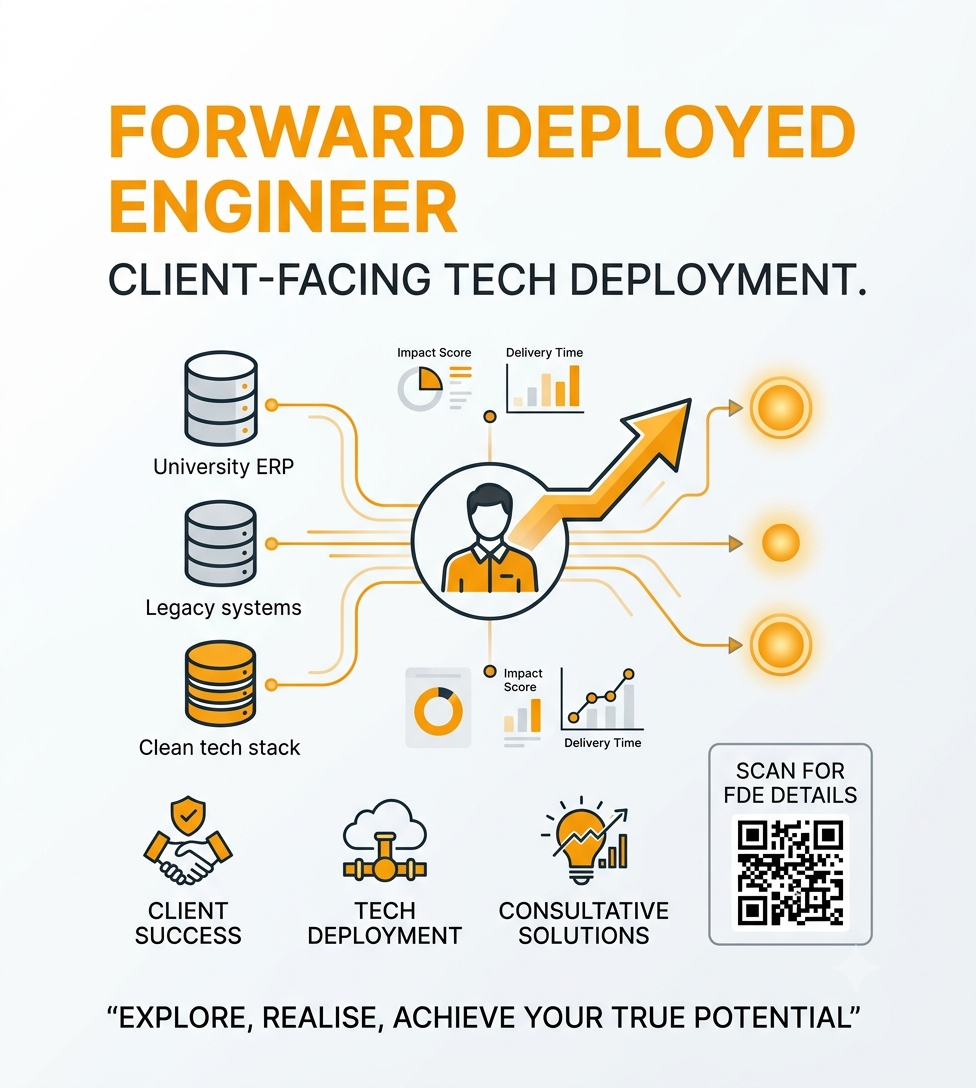
Forward Deployed Engineer
Bridging the gap between code and critical operations.
Introduction
Are you a technically gifted problem-solver who thrives on the front lines, turning complex software into operational realities? A Forward Deployed Engineer (FDE) is a highly skilled technical professional, often with a background in software engineering or computer science, who works directly with clients in their operational environments. They are the bridge between cutting-edge technology and practical application, responsible for deploying, integrating, customizing, and supporting software solutions. This role demands not only deep technical expertise but also strong communication, problem-solving, and client-facing skills. If you enjoy hands-on work, troubleshooting under pressure, and seeing your technical contributions have immediate, tangible impact, a career as an FDE might be your perfect launchpad.
Understanding the Forward Deployed Engineer Role
A Forward Deployed Engineer (FDE) is a technical specialist who works on-site with clients to implement, integrate, customize, and support software solutions. They are essentially the technical ambassadors for a company's products, ensuring that these solutions function effectively within the client's unique infrastructure and meet their specific business needs. This often involves a blend of software development, systems administration, and technical consulting. FDEs are crucial for successful product adoption and client satisfaction, acting as the primary technical point of contact during the crucial post-sale deployment phase. They troubleshoot issues, optimize performance, and provide training and ongoing support, ensuring clients derive maximum value from the technology.
Becoming a Forward Deployed Engineer typically involves a combination of strong academic foundations, hands-on technical experience, and developing crucial soft skills. Start with a bachelor's degree in a relevant field like Computer Science, Software Engineering, or Information Technology. Gain practical experience through internships, personal projects, or entry-level software development roles. Focus on acquiring skills in areas like programming (Python, Java, Go), cloud platforms (AWS, Azure, GCP), containerization (Docker, Kubernetes), and database management. Develop excellent communication, problem-solving, and client-facing abilities, as these are paramount. Networking within the industry and seeking out roles that involve client interaction or deployment can also pave the way.
The career path for a Forward Deployed Engineer is dynamic and offers significant growth potential. Entry-level roles often focus on assisting with deployments and basic troubleshooting. With experience, FDEs can move into senior roles, taking ownership of more complex deployments, leading client engagements, and mentoring junior team members. Beyond the FDE track, professionals might transition into roles like Solutions Architect, Technical Account Manager, Professional Services Consultant, or even move into management positions overseeing deployment teams. Some FDEs leverage their deep client and product knowledge to move into product management or sales engineering roles. The path is often dictated by individual strengths and interests, ranging from deeply technical specialization to client-facing leadership.
While related to other IT roles, the Forward Deployed Engineer has a distinct focus.
- Software Engineer: Primarily focused on designing, developing, and maintaining software in an R&D environment. FDEs use this development background but apply it to client-specific implementations.
- Solutions Architect: Designs high-level system architectures, often before development begins. FDEs are more hands-on with the actual deployment and integration of these solutions.
- System Administrator: Manages and maintains existing IT infrastructure. FDEs often work with client systems but their primary goal is deploying and integrating a specific product.
- Technical Support Engineer: Focuses on resolving post-deployment issues and providing ongoing user support. FDEs are involved in the initial deployment and integration, as well as providing advanced support during and immediately after that phase.
- Consultant: Offers advice and strategy. FDEs are technical implementers, bringing a deep product and integration expertise to the client's site.
What education and knowledge are essential for an FDE?
A strong foundation in computer science, software engineering, or a related technical field is crucial. This provides the theoretical underpinnings for understanding complex systems, algorithms, and data structures. Beyond formal education, continuous learning through online courses, documentation, and practical application is vital due to the rapidly evolving nature of technology.
Key subjects include programming languages (Python, Java, Go, JavaScript), data structures and algorithms, operating systems (Linux, Windows), networking fundamentals (TCP/IP, DNS, HTTP), database systems (SQL, NoSQL), cloud computing (AWS, Azure, GCP), cybersecurity principles, and software development methodologies (Agile, Waterfall). Understanding of system architecture and API integrations is also highly beneficial.
While a degree is often a prerequisite, specialized diploma and certification courses can significantly enhance an FDE's profile. Vendor-specific certifications from cloud providers (AWS Certified Solutions Architect, Azure Administrator Associate, Google Cloud Professional Cloud Architect), containerization platforms (Certified Kubernetes Administrator - CKA), and specific software product certifications demonstrate practical proficiency and are highly valued by employers. Short courses in areas like DevOps, cybersecurity, or specific programming languages can also be beneficial.
A Bachelor's degree in Computer Science, Software Engineering, Information Technology, or a closely related field usually provides a comprehensive understanding of core computing principles. Courses typically cover programming, data structures, algorithms, operating systems, computer networks, database management, and software engineering principles. Many programs also offer specializations or electives in areas like cloud computing, artificial intelligence, or cybersecurity, which are directly relevant to FDE roles.
A Master's degree, such as an M.S. in Computer Science or Software Engineering, can provide deeper theoretical knowledge and specialization. While not always mandatory for an FDE role, it can be advantageous for more complex technical challenges, research-oriented positions, or for accelerating career progression into senior or architectural roles. It demonstrates a commitment to advanced learning and analytical skills.
A PhD is generally not a requirement for a typical Forward Deployed Engineer role. However, for FDE positions within companies heavily involved in cutting-edge research and development, or for roles that require deep theoretical expertise in niche areas (e.g., AI/ML implementation, advanced algorithms), a PhD could be beneficial. It typically leads to roles focused on innovation, advanced problem-solving, or highly specialized consulting rather than standard client deployments.
Are there specific entrance exams for FDE roles?
Direct entrance exams for the 'Forward Deployed Engineer' title itself are uncommon. However, entrance exams for undergraduate and graduate programs in Computer Science, Software Engineering, and related IT fields are crucial if you are pursuing a formal degree. Exams like the GRE (for US graduate programs), GATE (for Indian engineering admissions), or specific university entrance tests determine admission into relevant educational institutions. Once employed, companies might use technical assessments or coding challenges as part of their hiring process to evaluate candidates' practical skills, rather than a formal entrance exam.
Where can one pursue education for this career?
Globally, many universities offer strong Computer Science and Software Engineering programs. In the US, top-tier institutions include MIT, Stanford University, Carnegie Mellon University, University of California - Berkeley, and the University of Illinois Urbana-Champaign. In the UK, you might look at the University of Cambridge, University of Oxford, Imperial College London, and University College London. Canada boasts universities like the University of Toronto, University of British Columbia, and University of Waterloo. Other notable global institutions include ETH Zurich (Switzerland), Nanyang Technological University (Singapore), and Tsinghua University (China).
In India, the Indian Institutes of Technology (IITs) are premier institutions for Computer Science and Engineering, including IIT Bombay, IIT Delhi, IIT Madras, IIT Kanpur, IIT Kharagpur, and IIT Hyderabad. Other highly respected institutions include the National Institutes of Technology (NITs), such as NIT Trichy and NIT Warangal, BITS Pilani, IIITs (International Institute of Information Technology), and Jadavpur University. Many private universities also offer strong IT and Computer Science programs.
What skills are essential for a Forward Deployed Engineer?
A Forward Deployed Engineer requires a robust blend of technical prowess and interpersonal skills.
Technical Skills:
- Programming: Proficiency in languages like Python, Java, Go, JavaScript.
- Cloud Computing: Expertise in AWS, Azure, or Google Cloud Platform.
- Containerization & Orchestration: Docker, Kubernetes.
- Operating Systems: Deep understanding of Linux and Windows Server.
- Databases: SQL and NoSQL database management.
- Networking: TCP/IP, DNS, HTTP, firewalls.
- Scripting: Bash, PowerShell.
- CI/CD Tools: Jenkins, GitLab CI, CircleCI.
- Infrastructure as Code (IaC): Terraform, Ansible.
- Monitoring & Logging: ELK Stack, Prometheus, Grafana.
- Troubleshooting: Ability to diagnose and resolve complex technical issues.
Soft Skills:
- Communication: Clearly explaining technical concepts to non-technical audiences.
- Problem-Solving: Analytical and critical thinking to tackle challenges.
- Client Management: Building rapport and trust with clients.
- Adaptability: Thriving in dynamic, often unpredictable client environments.
- Teamwork: Collaborating effectively with internal teams and client staff.
- Time Management: Prioritizing tasks and meeting deadlines.
- Presentation Skills: Effectively demonstrating software and training users.
What character traits are beneficial for an FDE?
Success as a Forward Deployed Engineer hinges on a specific set of dispositions. A proactive and 'can-do' attitude is paramount, as FDEs often face novel challenges requiring initiative. Resourcefulness is key – the ability to find solutions even with limited information or tools. Resilience helps in navigating complex problems and client pressures without losing focus. A strong sense of ownership and accountability ensures that client projects are seen through to successful completion. Curiosity drives continuous learning, essential in a rapidly evolving tech landscape. Finally, a customer-centric disposition ensures that the engineer always prioritizes the client's needs and success.
What personality types thrive as FDEs?
The ideal Forward Deployed Engineer personality is a blend of the analytical and the interpersonal. Individuals who are naturally curious, enjoy dissecting complex systems, and have a persistent drive to solve problems tend to excel. They should be comfortable with ambiguity and enjoy the challenge of applying theoretical knowledge to real-world, often messy, situations. People who are naturally good communicators, enjoy interacting with diverse groups of people, and can articulate technical details clearly will find success. Independence and self-motivation are important, as FDEs often work on client sites with a degree of autonomy. Adaptability and a calm demeanor under pressure are also hallmarks of successful FDEs, allowing them to navigate unexpected issues smoothly.
Exploring opportunities in the Forward Deployed Engineer field
Forward Deployed Engineer positions are typically offered by technology companies that provide software solutions, particularly those in SaaS, enterprise software, cloud services, and cybersecurity. These roles are often client-facing and require travel to customer sites. The job is dynamic, involving implementation, integration, customization, troubleshooting, and support of the company's products within the client's environment. FDEs are essential for ensuring successful product adoption and client satisfaction, acting as the technical bridge.
Yes, internships are a common and highly recommended way to gain experience as an aspiring Forward Deployed Engineer. Many tech companies offer 'Deployment Engineer Intern', 'Solutions Engineering Intern', or similar roles. These internships provide invaluable hands-on experience with client environments, software deployment processes, and the opportunity to work alongside experienced FDEs. Successfully completing an internship can often lead to a full-time offer upon graduation.
Part-time roles for Forward Deployed Engineers are less common due to the often project-based and client-site-dependent nature of the work. The role typically requires dedicated focus and availability during business hours, often at the client's location. However, some companies might offer part-time contract roles for specific, well-defined projects or for experienced individuals willing to work flexible hours, though these are typically the exception rather than the norm.
While the core FDE role is usually within a company structure, freelance opportunities can exist, particularly for highly specialized FDEs with a proven track record. This might involve contract work for specific deployment projects, consulting on integration strategies, or providing specialized support. However, building a freelance career as an FDE often requires extensive networking, establishing a strong personal brand, and demonstrating expertise that clients are willing to hire on a project basis, rather than the traditional salaried employee model.
Forward Deployed Engineers are most prevalent in industries that heavily rely on complex software solutions and require deep technical integration at the client level. Key industries include:
- Software as a Service (SaaS): Companies providing cloud-based software solutions.
- Cloud Computing Providers: AWS, Microsoft Azure, Google Cloud.
- Enterprise Software: ERP, CRM, HRIS systems.
- Cybersecurity: Companies offering security platforms and solutions.
- Data Analytics & Big Data: Firms providing platforms for data processing and insights.
- Fintech: Financial technology companies integrating software into banking and trading systems.
- Biotech & Healthcare Tech: Companies deploying specialized software for research, diagnostics, or patient management.
- Defense & Aerospace: Often require highly specialized and secure deployments.
- Forward Deployed Engineer
- Deployment Engineer
- Solutions Engineer
- Field Engineer (Technical)
- Technical Account Manager (with a deployment focus)
- Professional Services Engineer
- Implementation Consultant
- Customer Success Engineer
- Site Reliability Engineer (focus on deployment/integration)
- Cloud Deployment Specialist
Job openings for Forward Deployed Engineers can be found on major job boards like LinkedIn, Indeed, Glassdoor, and specialized tech job sites. Many companies list openings directly on their careers pages. Networking is crucial; attend industry conferences, connect with professionals in the field on LinkedIn, and engage with online communities. Consider reaching out to companies whose products or services you admire and inquire about potential FDE or related roles. University career services and technical recruitment agencies can also be valuable resources.
The outlook for Forward Deployed Engineers is generally strong and projected to grow. As businesses increasingly rely on sophisticated software solutions and cloud technologies, the demand for skilled professionals who can ensure seamless implementation and integration grows in parallel. The trend towards digital transformation across all industries fuels this demand. Roles that combine deep technical skills with client-facing capabilities are highly valued, suggesting a positive and stable career trajectory with opportunities for advancement and specialization.
What is the earning potential for an FDE?
The salary for a Forward Deployed Engineer can vary significantly based on several factors. These include the candidate's level of experience (entry-level vs. senior), the specific company and its size, the industry sector, the geographic location (major tech hubs typically offer higher salaries), and the complexity of the technologies involved. Additional compensation components like bonuses, stock options, and benefits packages are also common. The demand for skilled FDEs in the market also plays a role in determining competitive salary ranges. Overall, it is a well-compensated role within the tech industry, reflecting the critical nature of the position.
Can FDEs become entrepreneurs?
The skills and experience gained as a Forward Deployed Engineer provide an excellent foundation for entrepreneurship. FDEs develop a deep understanding of client needs, market challenges, and the practical application of technology. This hands-on experience with product implementation and client feedback can inspire the development of new solutions or services. An FDE might identify gaps in the market or inefficiencies that can be addressed with a startup. Their technical acumen allows them to build prototypes, and their client-facing experience aids in understanding market fit and customer acquisition strategies. They can leverage their network and understanding of technology trends to launch their own ventures.
Working as a Forward Deployed Engineer offers a structured career path with a predictable salary, benefits, and defined responsibilities within an established company. It provides opportunities for skill development and career progression under experienced leadership. Entrepreneurship, conversely, involves creating and running one's own business. It offers autonomy, potentially higher rewards, and the chance to bring a unique vision to life, but it comes with significant risks, long hours, financial uncertainty, and the responsibility for all aspects of the business. While an FDE job provides stability and specialization, entrepreneurship demands versatility, risk-taking, and a broad range of skills beyond technical implementation.
Gaining the necessary experience for an FDE role
Valuable experience for a Forward Deployed Engineer includes hands-on roles in software development, system administration, technical support, or IT consulting. Practical experience with deploying, configuring, and troubleshooting software in various environments (cloud, on-premise) is critical. Exposure to client-facing interactions, project management, and problem-solving in real-time scenarios is highly beneficial. Experience with specific technologies relevant to the target industry, such as cloud platforms (AWS, Azure, GCP), containerization (Docker, Kubernetes), scripting, and databases, is essential.
Academic projects, internships, and co-op programs undertaken during college provide foundational experience relevant to an FDE role. Coursework in programming, operating systems, networking, and databases builds theoretical knowledge. Capstone projects or group assignments that involve system design, implementation, and problem-solving simulate real-world technical challenges. Internships with technology companies, especially those focused on deployment, support, or solutions engineering, offer direct exposure to the professional environment and practical application of learned skills, making the transition to an FDE role smoother.
Formal training through degree programs provides the theoretical base. Beyond that, continuous technical training is vital. This includes vendor-specific training and certifications for cloud platforms (AWS, Azure, GCP), container orchestration (Kubernetes), and specific software products. Training in areas like cybersecurity, networking protocols, and advanced scripting is also highly beneficial. Soft skills training, focusing on communication, presentation, and client management, is equally important for success in client-facing roles. On-the-job training, mentorship from senior engineers, and self-directed learning through documentation and online resources are ongoing aspects of professional development.
Maximizing your potential and well-being as an FDE
Pros:
- Impactful Work: Directly contribute to client success and see immediate results.
- Technical Breadth: Work with diverse technologies and solve complex problems.
- Client Interaction: Develop strong communication and relationship-building skills.
- Dynamic Environment: Constantly learn and adapt to new challenges.
- Career Growth: Excellent opportunities for advancement into senior technical or management roles.
- Competitive Salary: Generally well-compensated due to specialized skills.
Cons:
- Travel: Often requires significant travel, which can be demanding.
- Pressure: High-pressure situations with tight deadlines and critical client systems.
- Work-Life Balance: Can be challenging due to client demands and travel.
- Constant Learning: Requires continuous upskilling to keep pace with technology.
- Client Issues: Dealing with client-specific infrastructure complexities and user issues.
Your 'Ikigai'—the intersection of what you love, what you are good at, what the world needs, and what you can be paid for—can be found in the Forward Deployed Engineer role. You might love complex problem-solving and technology. You are good at implementing and troubleshooting technical solutions. The world needs efficient, well-integrated software systems that drive business success. And this role is well-compensated. Finding your Ikigai means finding fulfillment by aligning your passion for technology and problem-solving with the tangible impact you make for clients, contributing to their operational efficiency and growth.
Achieving work-life balance as an FDE can be challenging due to travel and client demands. Strategies include setting clear boundaries with clients and your team, prioritizing tasks effectively, and utilizing downtime during travel for personal activities. Open communication with your manager about workload and travel expectations is key. When possible, choose roles with less frequent travel or focus on remote deployment opportunities. Making time for hobbies, exercise, and connecting with loved ones outside of work hours is crucial for long-term sustainability and preventing burnout.
The demanding nature of the FDE role, involving travel and high-pressure situations, can impact mental health. It's crucial to proactively manage stress through mindfulness, regular exercise, and adequate sleep. Building a strong support network, both personal and professional, is vital. Don't hesitate to utilize company resources like Employee Assistance Programs (EAPs). Setting realistic expectations, celebrating small wins, and taking scheduled breaks are essential for maintaining mental resilience. If you experience persistent stress or burnout, seeking professional help is a sign of strength.
A high Emotional Quotient (EQ) is critical for Forward Deployed Engineers. EQ encompasses self-awareness, self-regulation, motivation, empathy, and social skills. In client-facing roles, understanding and managing your own emotions, as well as recognizing and responding effectively to the emotions of clients and colleagues, is paramount. Empathy helps in understanding client frustrations and needs, while strong social skills facilitate collaboration and trust-building. Effective EQ allows FDEs to navigate difficult conversations, de-escalate conflicts, and build lasting client relationships, significantly contributing to project success beyond just technical execution.
A strong Intelligence Quotient (IQ) is foundational for a Forward Deployed Engineer. It represents cognitive abilities such as logical reasoning, problem-solving, abstract thinking, and learning capacity. FDEs constantly encounter complex technical puzzles that require analytical thinking and the ability to process information quickly. A high IQ enables them to grasp intricate system architectures, understand complex code, diagnose challenging issues, and learn new technologies efficiently. It's the bedrock upon which technical expertise is built, allowing for the effective application of knowledge in dynamic and demanding situations.
The working environment for a Forward Deployed Engineer is highly variable. A significant portion of the job is spent on-site at client locations, which can range from corporate offices to data centers or manufacturing facilities. This means adapting to different workplace cultures, IT infrastructures, and team dynamics. When not on-site, FDEs often work remotely or from their company's office, collaborating with their internal teams. The environment is typically fast-paced, often requiring problem-solving under pressure, and necessitates adaptability to changing priorities and client needs. It's a blend of independent work, team collaboration, and direct client engagement.
What tools and resources are indispensable for FDEs?
Forward Deployed Engineers utilize a wide array of tools:
Development & Scripting: IDEs (VS Code, IntelliJ), text editors, Git (for version control). Cloud Platforms: AWS Console/CLI, Azure Portal/CLI, Google Cloud Console/CLI. Containerization: Docker Desktop, Kubernetes CLI (kubectl). Operating Systems: SSH clients (PuTTY, Termius), remote desktop tools, Linux terminal. Networking Tools: Ping, Traceroute, Wireshark, Nmap. Databases: SQL clients (DBeaver, pgAdmin), MongoDB Compass. Monitoring: Tools like Datadog, Splunk, Prometheus, Grafana. Collaboration: Slack, Microsoft Teams, Jira, Confluence. Documentation: Internal wikis, vendor documentation, Stack Overflow. Hardware: Laptops, sometimes mobile hotspots or diagnostic hardware.
While not always strictly mandatory, certain licenses and certifications significantly enhance an FDE's credibility and marketability. Key certifications include those from major cloud providers (AWS Certified Solutions Architect, Azure Administrator Associate, Google Cloud Professional Cloud Architect), container orchestration platforms (Certified Kubernetes Administrator - CKA), and security certifications (CompTIA Security+). Vendor-specific certifications for the software products the FDE's company offers are also crucial. These demonstrate validated expertise and a commitment to professional development.
While there isn't one single dominant professional association exclusively for Forward Deployed Engineers, several organizations and communities are highly relevant. The Association for Computing Machinery (ACM) and the Institute of Electrical and Electronics Engineers (IEEE) Computer Society offer broad resources for computing professionals. Communities around specific technologies, such as the Cloud Native Computing Foundation (CNCF) for Kubernetes, or user groups for specific software vendors, are invaluable. Networking platforms like LinkedIn and attending tech conferences (e.g., AWS re:Invent, Microsoft Ignite, KubeCon) also serve as vital professional resources.
Common questions about the Forward Deployed Engineer career
Q1: Is travel a mandatory part of every FDE role? A: While travel is common, the extent varies. Some roles require frequent on-site client visits, while others might focus more on remote deployments or have limited travel requirements.
Q2: What's the difference between an FDE and a Technical Support Engineer? A: FDEs focus on initial deployment, integration, and customization, acting as the primary technical contact during these phases. Technical Support typically handles post-deployment issues and ongoing user problems.
Q3: Do I need a degree in Computer Science? A: A degree in CS or a related field is highly preferred, providing a strong theoretical foundation. However, exceptional practical experience and certifications can sometimes bridge the gap.
Q4: How important are soft skills compared to technical skills? A: Both are equally crucial. Technical skills get you the interview, but strong communication, problem-solving, and client management skills are essential for success and career advancement in this client-facing role.
Q5: What is the typical career progression? A: Progression often leads to Senior FDE, Lead Engineer, Solutions Architect, Technical Account Manager, or management roles overseeing deployment teams.
Advice for aspiring and current FDEs
- Master Your Fundamentals: Ensure a solid grasp of operating systems, networking, databases, and core programming concepts.
- Become a Cloud Expert: Gain proficiency in at least one major cloud platform (AWS, Azure, GCP).
- Embrace Automation: Learn scripting and tools like Docker and Kubernetes to automate deployments and management.
- Develop Communication Skills: Practice explaining technical concepts clearly and concisely to non-technical audiences.
- Build Your Network: Connect with other engineers, attend meetups, and engage in online communities.
- Seek Mentorship: Learn from experienced FDEs or senior technical professionals.
- Stay Curious: Continuously learn new technologies and follow industry trends.
- Document Everything: Maintain clear records of deployments, configurations, and troubleshooting steps.
- Prioritize Client Success: Always focus on delivering value and solving the client's problems effectively.
- Manage Your Time and Travel: Develop strategies for staying organized and maintaining well-being amidst demanding schedules.
A concise recap of the FDE role
The Forward Deployed Engineer (FDE) is a vital technical role focused on implementing, integrating, and supporting software solutions directly within client environments. It demands a strong blend of technical expertise in areas like cloud computing, programming, and systems administration, coupled with excellent communication, problem-solving, and client-facing skills. While requiring dedication, adaptability, and often travel, the FDE career path offers significant opportunities for impactful work, continuous learning, and professional growth within the dynamic information technology sector. It's an ideal role for technically adept individuals who enjoy hands-on problem-solving and making a tangible difference for clients.