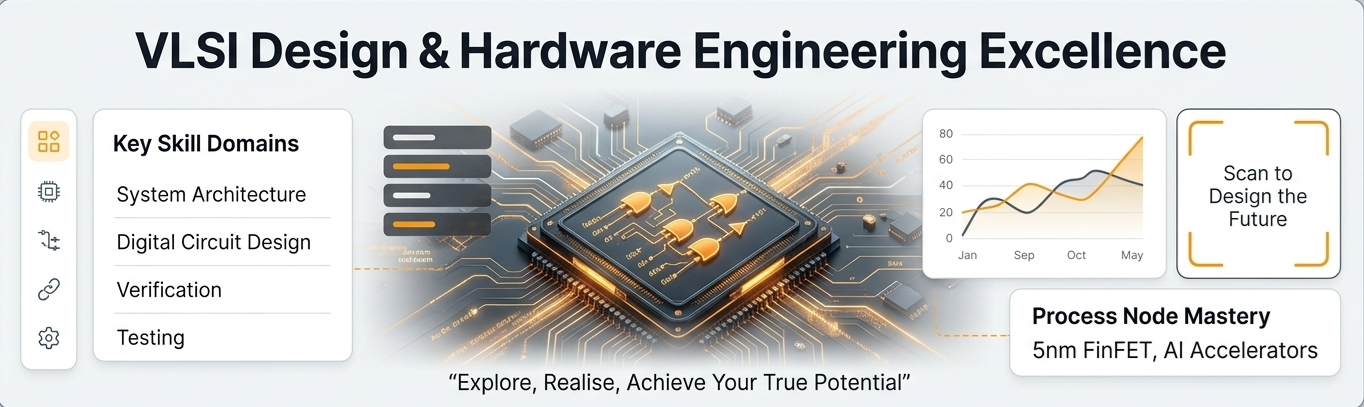
VLSI Design and Hardware Engineer
Design the Future, Chip by Chip: Master the Art of VLSI and Hardware Engineering.
Introduction
Welcome to the exciting world of VLSI Design and Hardware Engineering! If you're fascinated by how the smallest components power the biggest innovations, from your smartphone to supercomputers, this field is for you. VLSI (Very Large Scale Integration) engineers and hardware engineers are the architects of the digital age, responsible for designing, developing, and testing the integrated circuits (ICs) and electronic systems that form the backbone of modern technology. This career path is ideal for individuals with a strong aptitude for problem-solving, a keen eye for detail, and a passion for cutting-edge technology. It demands a blend of theoretical knowledge in electronics and computer science, coupled with practical skills in hardware description languages and design tools. If you dream of creating the next generation of powerful and efficient electronic devices, delve deeper into this dynamic and rewarding field.
Unveiling the World of VLSI Design and Hardware Engineering
VLSI Design and Hardware Engineering is a specialized field within electrical and computer engineering focused on the design, development, verification, and fabrication of integrated circuits (ICs) or 'chips' and the underlying hardware systems. VLSI engineers work on creating complex microprocessors, memory chips, graphics processors, and other semiconductor devices that are fundamental to virtually all electronic products. Hardware engineers, a broader category, also design and develop the physical components of computer systems, including motherboards, processors, memory modules, and peripheral devices, ensuring they function efficiently and meet performance specifications. This field is critical for technological advancement, driving innovation in areas like artificial intelligence, high-performance computing, mobile devices, and the Internet of Things (IoT).
Becoming a VLSI Design and Hardware Engineer typically involves a structured educational path followed by practical experience.
- Foundation: Obtain a strong academic foundation in science and mathematics, particularly in physics and advanced algebra, during high school.
- Education: Pursue a Bachelor's degree in Electrical Engineering, Electronics and Communication Engineering, Computer Engineering, or a related field. Specialization in VLSI design or digital electronics is highly beneficial.
- Advanced Studies (Optional but Recommended): A Master's degree or Ph.D. in VLSI Design, Microelectronics, or Computer Engineering can open doors to more advanced research and development roles.
- Skill Development: Gain proficiency in essential hardware description languages (HDLs) like Verilog and VHDL, and learn to use industry-standard Electronic Design Automation (EDA) tools (e.g., Cadence, Synopsys, Mentor Graphics).
- Practical Experience: Engage in internships, research projects, and build personal projects to gain hands-on experience.
- Continuous Learning: Stay updated with the latest advancements in semiconductor technology, design methodologies, and emerging trends.
The career path for a VLSI Design and Hardware Engineer is progressive and offers opportunities for specialization and leadership.
- Entry-Level: Junior Engineer, Design Engineer, Verification Engineer, Layout Engineer. At this stage, you'll work under senior engineers, contributing to specific modules or tasks within a larger design project.
- Mid-Level: Senior Design Engineer, Senior Verification Engineer, Project Engineer. With experience, you'll take on more complex design challenges, lead small teams, and contribute to architectural decisions.
- Senior/Lead Roles: Lead Engineer, Architect, Technical Manager, R&D Scientist. In these positions, you'll be responsible for the overall design strategy, manage large teams, mentor junior engineers, and drive innovation.
- Specializations: Engineers can specialize in areas like CPU design, GPU design, AI chip design, low-power design, analog/mixed-signal design, physical design, or verification.
- Management Track: Some may transition into project management or engineering management roles, focusing on resource allocation, scheduling, and team leadership.
While often used interchangeably, VLSI Design and Hardware Engineering have distinct focuses:
VLSI Design Engineering: Primarily concerned with the design and creation of integrated circuits (ICs) or microchips. This involves conceptualizing the chip architecture, writing code in HDLs (Verilog/VHDL) to describe the logic, simulating the design, and ensuring it meets specifications before fabrication. It's a highly specialized domain within hardware engineering.
Hardware Engineering: A broader field that encompasses the design, development, testing, and maintenance of all types of computer hardware. This includes not only ICs but also larger systems like motherboards, processors, memory modules, circuit boards, and other physical components of electronic devices. A hardware engineer might work on system-level integration, board design, or even the physical infrastructure of data centers.
In essence, VLSI design is a deep dive into the micro-level creation of chips, while hardware engineering is the overarching discipline of building and integrating the physical technological components.
Building Your Foundation: Essential Education and Knowledge
A robust educational background is paramount for a career in VLSI Design and Hardware Engineering. This field demands a deep understanding of electrical engineering principles, computer architecture, and advanced mathematics. A strong theoretical base allows engineers to grasp complex concepts, innovate solutions, and debug intricate problems. Continuous learning is also a key component, as the technology landscape evolves rapidly. Beyond formal education, self-study, online courses, and hands-on projects play a crucial role in staying relevant and competitive.
The curriculum for aspiring VLSI and Hardware Engineers is rigorous and comprehensive. Key subjects include:
- Digital Logic Design: Understanding Boolean algebra, logic gates, combinational and sequential circuits.
- Computer Architecture: Learning about CPU design, memory hierarchy, instruction set architectures, and performance evaluation.
- Microprocessor and Microcontroller Principles: In-depth study of processor operation and embedded systems.
- Semiconductor Physics and Devices: Understanding the fundamental physics behind transistors and other semiconductor components.
- VLSI Design: Principles of IC design, including system-level design, RTL design, logic synthesis, physical design, and verification.
- Circuit Theory: Analysis of analog and digital circuits.
- Electromagnetics: Understanding wave propagation and signal integrity.
- Data Structures and Algorithms: Essential for efficient software development and system design.
- Operating Systems: Understanding system-level software and hardware interaction.
- Signal Processing: Concepts applicable in various hardware designs.
While a Bachelor's degree is usually the minimum requirement, diploma and certification courses can supplement formal education, especially for specific skills or to bridge knowledge gaps. These courses often focus on practical applications and specific tools. Examples include:
- VLSI Design Certifications: Offered by tool vendors (e.g., Cadence, Synopsys) or specialized training institutes, covering areas like RTL design, verification, or physical design.
- FPGA Design Courses: Focus on Field-Programmable Gate Arrays, often using HDLs for rapid prototyping.
- Embedded Systems Design: Certifications in embedded C/C++, RTOS, and specific microcontroller architectures.
- Semiconductor Technology Courses: Short courses on fabrication processes or specific device technologies.
A Bachelor of Technology (B.Tech.) or Bachelor of Engineering (B.E.) degree is the standard entry point. Common specializations include:
- Electrical Engineering (EE): Provides a broad foundation in electrical systems.
- Electronics and Communication Engineering (ECE): Focuses on communication systems and electronic devices, often with VLSI electives.
- Computer Engineering (CE): Blends electrical engineering with computer science, covering hardware and software aspects.
- Electronics Engineering: Similar to ECE but may have a stronger emphasis on electronic circuits and devices.
During graduation, students will complete core engineering subjects and then often choose electives or a specialization track focusing on microelectronics, VLSI, digital systems, or computer architecture.
A Master of Technology (M.Tech.) or Master of Science (M.S.) degree is highly recommended for those seeking specialized roles, research positions, or higher-level design challenges. Master's programs allow for deeper specialization in areas such as:
- VLSI Design and Embedded Systems
- Microelectronics and VLSI Technology
- Computer Engineering with a VLSI focus
- Digital Signal Processing for Hardware
- Advanced Computer Architecture
A Master's degree often involves advanced coursework and a significant research project or thesis, providing hands-on experience with cutting-edge technologies and methodologies.
A Ph.D. is typically pursued by individuals aspiring to lead groundbreaking research and development, innovate new technologies, or pursue academic careers as professors. Ph.D. programs involve extensive coursework followed by several years of independent research, culminating in a dissertation that makes a novel contribution to the field. Specializations at the Ph.D. level can include novel transistor structures, advanced VLSI architectures, new verification methodologies, AI hardware acceleration, or quantum computing hardware. This path is for those with a deep passion for theoretical exploration and pushing the boundaries of technological possibility.
Gaining Admission: Key Entrance Examinations
Admission to undergraduate and postgraduate programs in VLSI Design and Hardware Engineering often requires competitive entrance exams. These exams assess a candidate's aptitude in physics, mathematics, chemistry, and logical reasoning.
For Undergraduate Programs (B.Tech/B.E.):
- India: JEE (Main & Advanced) for IITs and NITs, state-level engineering entrance exams (e.g., TS EAMCET, AP EAMCET, KCET, MHT CET).
- International: SAT, ACT (primarily for US universities).
For Postgraduate Programs (M.Tech/M.S.):
- India: GATE (Graduate Aptitude Test in Engineering) is crucial for admissions to M.Tech programs in IITs, IISc, and other reputed institutions, often with scholarships. Some institutes also conduct their own entrance exams.
- International: GRE (Graduate Record Examinations) is widely accepted for Master's and Ph.D. programs in the US and many other countries. TOEFL or IELTS are required for non-native English speakers to demonstrate English proficiency.
Where to Learn: Premier Educational Institutions
Many world-class universities offer excellent programs in VLSI Design and Hardware Engineering. These institutions are known for their cutting-edge research, state-of-the-art facilities, and strong industry connections.
United States: Stanford University, Massachusetts Institute of Technology (MIT), University of California - Berkeley, Carnegie Mellon University, University of Illinois Urbana-Champaign (UIUC), Georgia Institute of Technology.
Europe: ETH Zurich (Switzerland), Delft University of Technology (Netherlands), University of Cambridge (UK), Imperial College London (UK), Technical University of Munich (Germany).
Asia: National University of Singapore (NUS), Nanyang Technological University (NTU Singapore), Tsinghua University (China), University of Tokyo (Japan).
India boasts several premier institutions that provide high-quality education and research opportunities in VLSI Design and Hardware Engineering.
Indian Institutes of Technology (IITs): IIT Bombay, IIT Delhi, IIT Madras, IIT Kanpur, IIT Kharagpur, IIT Hyderabad, IIT Roorkee, IIT Guwahati, IIT Gandhinagar offer specialized M.Tech programs and significant research in VLSI and related fields.
Indian Institute of Science (IISc) Bangalore: Renowned for its research intensity, offering M.Tech and Ph.D. programs with strong VLSI and Microelectronics focus.
National Institutes of Technology (NITs): Many NITs, such as NIT Trichy, NIT Surathkal, NIT Warangal, also offer relevant undergraduate and postgraduate programs.
Other Reputed Institutions: Birla Institute of Technology and Science (BITS) Pilani, Indian Institute of Information Technology (IIITs) often have strong departments with VLSI specializations.
Essential Skills for Success in VLSI and Hardware Engineering
Success in VLSI Design and Hardware Engineering requires a blend of strong technical expertise and crucial soft skills.
Technical Skills:
- Hardware Description Languages (HDLs): Proficiency in Verilog and VHDL is fundamental for designing and describing digital circuits.
- EDA Tools: Expertise in industry-standard Electronic Design Automation tools from vendors like Cadence, Synopsys, and Mentor Graphics for synthesis, simulation, place & route, and verification.
- Digital Logic Design: Deep understanding of Boolean algebra, logic gates, state machines, and digital system design.
- Computer Architecture: Knowledge of processor design, memory systems, and bus protocols.
- Semiconductor Physics: Understanding the underlying principles of semiconductor devices.
- Programming Languages: Proficiency in C/C++ for verification, scripting (Python, Perl, Tcl) for automation, and potentially higher-level languages for system-level modeling.
- Circuit Simulation: Experience with SPICE and other circuit simulators for analog/mixed-signal design.
- Verification Methodologies: Familiarity with UVM (Universal Verification Methodology) or other advanced verification techniques.
Soft Skills:
- Problem-Solving: Ability to analyze complex issues and devise effective solutions.
- Analytical Thinking: Capacity to break down intricate systems and understand their interactions.
- Attention to Detail: Crucial for identifying subtle bugs in designs.
- Teamwork and Collaboration: Essential for working effectively in design teams.
- Communication Skills: Clearly articulating technical concepts to peers and stakeholders.
- Adaptability and Continuous Learning: Staying updated with rapidly evolving technologies.
The Mindset for a VLSI and Hardware Engineer
Beyond technical skills, certain personal dispositions are vital for thriving in VLSI Design and Hardware Engineering. These traits enable engineers to navigate challenges, collaborate effectively, and maintain high standards of work.
- Curiosity: A natural desire to understand how things work at a fundamental level and to explore new technological frontiers.
- Persistence: The ability to persevere through complex design cycles, debugging intricate issues, and overcoming setbacks.
- Methodical Approach: A systematic way of thinking and working, ensuring thoroughness in design, verification, and testing.
- Innovation Mindset: A drive to create novel solutions and improve existing designs for better performance, efficiency, or cost.
- Responsibility: Taking ownership of designs and ensuring they meet quality and reliability standards.
- Openness to Feedback: Willingness to accept constructive criticism and learn from others' perspectives.
- Discipline: Adhering to project timelines, design rules, and best practices.
Who Thrives as a VLSI and Hardware Engineer?
While diverse personalities can succeed, certain traits often align well with the demands of VLSI Design and Hardware Engineering:
- The Analytical Thinker: Someone who enjoys dissecting complex problems, identifying patterns, and applying logical reasoning.
- The Detail-Oriented Creator: A person who possesses meticulousness and can focus on the fine points of a design while also having a vision for the final product.
- The Patient Problem-Solver: Individuals who are not easily discouraged by challenges and can systematically work through intricate debugging processes.
- The Collaborative Innovator: Someone who enjoys working in teams, sharing ideas, and contributing to collective goals, while also bringing creative solutions.
- The Lifelong Learner: A personality type that is intrinsically motivated to stay updated with technological advancements and eager to acquire new skills.
- The Pragmatist: Someone who balances theoretical knowledge with practical constraints, aiming for efficient and manufacturable designs.
If you find satisfaction in building, testing, and optimizing complex systems, enjoy deep technical challenges, and have a passion for electronics, this career path could be a great fit.
Opportunities in VLSI Design and Hardware Engineering
VLSI Design and Hardware Engineering roles are central to the technology industry, involving the creation of the essential components that power our digital world. These roles are demanding but offer immense satisfaction through tangible contributions to innovation.
Typical job titles include:
- VLSI Design Engineer
- Hardware Design Engineer
- Verification Engineer
- Physical Design Engineer (Layout Engineer)
- ASIC Design Engineer
- FPGA Engineer
- Digital Design Engineer
- Analog/Mixed-Signal Design Engineer
- Embedded Systems Engineer
- Computer Architect
- Test Engineer
- SoC (System-on-Chip) Designer
Internships are invaluable for students pursuing a career in VLSI Design and Hardware Engineering. They provide practical exposure to industry tools, methodologies, and team dynamics. Interns often work on specific tasks under the guidance of experienced engineers, contributing to real projects. This experience is crucial for:
- Understanding industry practices.
- Applying academic knowledge.
- Building a professional network.
- Exploring different specialization areas (e.g., verification, physical design).
- Enhancing resume and increasing job prospects upon graduation.
Many leading semiconductor companies, R&D labs, and technology firms offer structured internship programs.
Part-time roles in VLSI Design and Hardware Engineering are less common for core design positions, especially for entry-level roles due to the complexity and project-oriented nature of the work. However, opportunities might arise in:
- Research Assistant roles: Part-time support for university research projects.
- Technical Documentation: Creating manuals or documentation for hardware products.
- Teaching Assistant roles: Assisting professors in undergraduate courses.
- Specific testing or analysis tasks: For individuals with specialized skills who can be engaged on a project basis.
These are often more accessible to graduate students or experienced professionals looking for flexible engagements.
Freelancing in VLSI Design and Hardware Engineering is challenging due to the high-end tools, proprietary knowledge, and long project cycles involved. However, opportunities exist for highly experienced professionals, particularly in:
- Consultancy: Providing expert advice on design methodologies, tool selection, or project planning.
- Specialized Verification Tasks: Taking on specific verification modules or testbench development.
- Custom IP Development: Designing reusable intellectual property blocks.
- Tool Scripting and Automation: Developing custom scripts or flows for EDA tools.
- Training: Offering specialized training on HDLs or EDA tools.
Freelancers typically need to build a strong reputation and portfolio to secure such engagements, often working with smaller companies or startups that may not have in-house expertise.
VLSI Design and Hardware Engineers are integral to numerous industries driving technological advancement:
- Semiconductor Industry: Chip manufacturers (e.g., Intel, AMD, NVIDIA, Qualcomm, Broadcom) and foundries (e.g., TSMC, Samsung, GlobalFoundries).
- Consumer Electronics: Companies designing smartphones, laptops, tablets, wearables, smart home devices (e.g., Apple, Samsung, Google).
- Automotive Industry: Developing advanced driver-assistance systems (ADAS), infotainment systems, and electric vehicle (EV) components.
- Aerospace and Defense: Designing complex systems for aircraft, satellites, and defense equipment.
- Medical Devices: Creating sophisticated hardware for diagnostic equipment, implants, and monitoring systems.
- Telecommunications: Designing network infrastructure, modems, and communication chips.
- High-Performance Computing (HPC) and Data Centers: Building powerful servers, networking equipment, and specialized accelerators.
- Internet of Things (IoT): Developing chips and hardware for a wide range of connected devices.
- Research and Development (R&D): Both in industry and academia, pushing the boundaries of semiconductor technology.
Here's a list of common job roles in VLSI Design and Hardware Engineering:
Design Roles:
- ASIC Design Engineer
- FPGA Design Engineer
- Digital Design Engineer
- RTL Designer
- SoC Designer
- Analog/Mixed-Signal Design Engineer
- CPU/GPU/GPU Design Engineer
Verification Roles:
- Verification Engineer
- Senior Verification Engineer
- UVM Engineer
- Formal Verification Engineer
Physical Design Roles:
- Physical Design Engineer
- Layout Engineer
- Timing Closure Engineer
- Static Timing Analysis (STA) Engineer
Other Related Roles:
- Hardware Engineer
- Embedded Systems Engineer
- Computer Architect
- Test Engineer
- DFT (Design for Testability) Engineer
- Application Engineer (Technical Support)
Finding a job in VLSI Design and Hardware Engineering involves a multi-pronged approach:
- Build a Strong Resume: Highlight relevant coursework, projects, internships, technical skills (HDLs, EDA tools), and any publications or contributions.
- Network: Attend industry conferences, career fairs, and university events. Connect with professionals on platforms like LinkedIn.
- Online Job Portals: Utilize major job sites (LinkedIn, Indeed, Glassdoor) and specialized engineering job boards. Set up alerts for relevant keywords.
- Company Career Pages: Directly check the careers sections of semiconductor companies, tech giants, and startups.
- University Career Services: Leverage your university's career services for job postings, resume reviews, and interview preparation.
- Referrals: Seek referrals from contacts within the industry, as they can significantly boost your application's visibility.
- Prepare for Interviews: Be ready for technical interviews covering digital logic, computer architecture, HDLs, verification concepts, and problem-solving scenarios. Behavioral questions are also common.
The demand for skilled VLSI Design and Hardware Engineers is projected to remain strong and experience significant growth, driven by several factors:
- Increasing Complexity of Devices: The constant push for more powerful, energy-efficient, and feature-rich electronic devices requires increasingly sophisticated chip designs.
- Emergence of New Technologies: AI/ML, 5G/6G communication, autonomous vehicles, IoT, and virtual/augmented reality all rely heavily on custom-designed hardware and advanced ICs.
- Global Semiconductor Demand: Despite cyclical trends, the long-term demand for semiconductors across all sectors continues to rise.
- Technological Advancements: Innovations in chip architecture, materials, and manufacturing processes create new opportunities and require specialized expertise.
While the field is competitive, those with up-to-date skills, a solid educational background, and practical experience are well-positioned for excellent career prospects and growth.
Understanding Compensation in VLSI and Hardware Engineering
Salaries for VLSI Design and Hardware Engineers are generally competitive, reflecting the high demand, specialized skills, and critical nature of the work. Compensation varies significantly based on factors such as:
- Experience Level: Entry-level salaries are lower than those for senior engineers or architects.
- Location: Major tech hubs often offer higher salaries due to higher cost of living and concentration of companies.
- Company Size and Type: Large multinational corporations and successful startups may offer different compensation packages.
- Specialization: Niche areas or highly in-demand skills (e.g., AI hardware acceleration, advanced verification) can command higher pay.
- Education: A Master's or Ph.D. degree can often lead to higher starting salaries and faster career progression.
Typical salary ranges (in USD, subject to change and location):
- Entry-Level (0-3 years): $70,000 - $100,000
- Mid-Level (3-8 years): $90,000 - $140,000
- Senior Level (8+ years): $130,000 - $200,000+
- Lead/Architect/Manager: $180,000 - $250,000+ (often with bonuses and stock options).
These figures often do not include bonuses, stock options, or other benefits, which can significantly increase total compensation, especially in established tech companies.
Founding Your Own Venture in VLSI and Hardware
Entrepreneurship in VLSI Design and Hardware Engineering is challenging but incredibly rewarding. It involves identifying unmet needs in the market and developing innovative hardware solutions. This path requires not only deep technical expertise but also strong business acumen, fundraising skills, and leadership qualities. Entrepreneurs might focus on:
- Designing specialized ICs: Creating custom chips for emerging markets like AI, IoT, or specialized computing.
- Developing novel hardware platforms: Building new architectures or development boards for specific applications.
- Providing advanced design services: Offering niche expertise in areas like verification, low-power design, or security.
- Creating innovative EDA tools or methodologies: Developing software or services that improve the design process.
Successful hardware startups often require significant capital investment for R&D, prototyping, and fabrication, making fundraising a critical aspect of the entrepreneurial journey.
Choosing between entrepreneurship and a traditional job in VLSI Design and Hardware Engineering depends on personal goals, risk tolerance, and aspirations.
Entrepreneurship:
- Pros: Full autonomy, potential for immense financial reward and impact, direct control over innovation and vision.
- Cons: High risk of failure, immense personal investment of time and resources, constant pressure, need for broad skill set (business, marketing, sales), fundraising challenges.
Jobs:
- Pros: Stable income and benefits, structured career path, access to company resources and expertise, focus on specialized technical tasks, lower personal financial risk.
- Cons: Limited autonomy, less direct control over vision, potentially slower career progression, need to align with company goals.
For many, starting as an engineer in a company provides a solid foundation, learning the industry, and building networks before considering entrepreneurship.
Gaining and Leveraging Practical Experience
Practical experience is indispensable in VLSI Design and Hardware Engineering. It transforms theoretical knowledge into tangible skills and problem-solving capabilities. Employers highly value candidates who have demonstrated their ability to apply concepts in real-world scenarios. Experience can be gained through:
- Internships: Working with companies on actual projects.
- University Research Projects: Contributing to faculty research, often involving design, simulation, or fabrication.
- Personal Projects: Building custom hardware, designing FPGAs, or developing complex digital logic on development boards.
- Competitions: Participating in robotics, embedded systems, or chip design competitions.
- Entry-Level Positions: The first few years in a junior engineering role are critical for developing core competencies.
The relationship between college work and the professional engineering world is symbiotic. Academic projects and coursework provide the foundational knowledge, while industry internships and capstone projects offer a glimpse into real-world engineering challenges. Universities often collaborate with industry partners on research, providing students with exposure to cutting-edge technologies and methodologies. Strong academic performance in core subjects, coupled with practical project experience, is key to transitioning smoothly from college to a career. Building a portfolio of projects, demonstrating proficiency in design tools, and engaging in networking opportunities further solidify this connection.
Formal training and continuous learning are vital throughout a VLSI Design and Hardware Engineer's career. Companies often provide internal training programs, and external certifications are also common. Key areas for training include:
- Tool-Specific Training: Mastering new versions or advanced features of EDA tools (Cadence, Synopsys, Mentor Graphics).
- Methodology Training: Learning advanced verification techniques (e.g., UVM), formal verification, or specific physical design flows.
- New Technology Training: Keeping up with advancements in areas like AI hardware, low-power design, security in hardware, or advanced packaging.
- Programming and Scripting: Enhancing skills in Python, C++, or Tcl for automation and advanced verification.
- Soft Skills Training: Improving communication, leadership, and project management abilities.
Professional development ensures engineers remain adaptable and valuable in a rapidly evolving technological landscape.
Thriving in Your VLSI and Hardware Engineering Career
Pros:
- Impactful Work: You design the fundamental components that power modern technology.
- High Demand: Strong job market with excellent career prospects and growth.
- Competitive Salaries: Generally offers attractive compensation packages.
- Intellectual Stimulation: Constantly solving complex technical challenges.
- Innovation: Opportunity to work on cutting-edge technologies (AI, 5G, IoT).
- Global Opportunities: Semiconductor industry is global, offering diverse work locations.
Cons:
- Steep Learning Curve: Requires deep technical knowledge and continuous learning.
- Intense Competition: Highly specialized field with competitive job market.
- Long Project Cycles: Designs can take years from concept to production.
- Debugging Frustration: Finding subtle bugs in complex designs can be time-consuming and challenging.
- High Pressure: Deadlines and performance requirements can be demanding.
- Tool Dependency: Reliance on expensive and complex EDA software.
Your Ikigai – the intersection of what you love, what you are good at, what the world needs, and what you can be paid for – can be found in VLSI Design and Hardware Engineering if:
- What you love: You are passionate about electronics, how computers work, and solving intricate technical puzzles.
- What you are good at: You possess strong analytical skills, a knack for logic, meticulous attention to detail, and proficiency in mathematics and physics.
- What the world needs: The world requires increasingly powerful, efficient, and innovative electronic devices and systems, from AI accelerators to IoT sensors and communication chips.
- What you can be paid for: Your specialized skills in designing and verifying these critical components are highly valued by the technology industry.
Finding this balance means contributing meaningfully to technological progress while achieving personal and professional fulfillment.
Work-life balance in VLSI Design and Hardware Engineering can be challenging, especially during critical project phases or when facing tight deadlines. However, many companies are increasingly prioritizing employee well-being. Factors influencing balance include:
- Company Culture: Some companies offer more flexibility, remote work options, and reasonable working hours than others.
- Project Deadlines: Intense periods requiring longer hours are common before product launches or tape-outs (the final step before chip manufacturing).
- Personal Management: Effective time management, prioritization, and setting boundaries are crucial.
- Remote Work: Growing acceptance of remote or hybrid models can offer more flexibility for some roles.
While demanding, achieving a sustainable balance is possible with conscious effort and by choosing employers that value it. Setting realistic expectations about work intensity during certain periods is key.
The demanding nature of VLSI Design and Hardware Engineering can pose challenges to mental health. High pressure, complex problem-solving, and long hours can lead to stress, burnout, and anxiety. Key strategies for maintaining mental well-being include:
- Mindfulness and Stress Management Techniques: Practicing meditation, deep breathing, or other relaxation methods.
- Healthy Lifestyle: Maintaining a balanced diet, regular exercise, and adequate sleep.
- Setting Boundaries: Learning to say no when overloaded and protecting personal time.
- Seeking Support: Talking to friends, family, or mental health professionals.
- Taking Breaks: Stepping away from work during challenging periods to reset.
- Company Resources: Utilizing Employee Assistance Programs (EAPs) or mental health benefits offered by employers.
- Focus on Small Wins: Celebrating progress during long and complex projects.
Emotional Quotient (EQ) is increasingly recognized as vital for success in collaborative environments like VLSI design teams. High EQ enables engineers to:
- Communicate Effectively: Understand and convey complex technical information clearly and empathetically.
- Manage Conflict: Navigate disagreements within teams constructively.
- Build Strong Relationships: Foster trust and rapport with colleagues, managers, and stakeholders.
- Lead and Motivate: Inspire team members and manage project dynamics effectively.
- Adapt to Change: Handle project shifts or challenges with resilience and a positive attitude.
- Empathize: Understand the perspectives and pressures faced by other team members.
Developing EQ complements technical skills, leading to more effective teamwork, better project outcomes, and a more positive work environment.
Intelligence Quotient (IQ) is fundamental to VLSI Design and Hardware Engineering, as the role demands strong cognitive abilities. A high IQ is generally associated with:
- Abstract Reasoning: The ability to understand complex theoretical concepts and models.
- Logical Problem-Solving: Devising systematic solutions to intricate technical issues.
- Analytical Skills: Breaking down complex systems and data into manageable parts.
- Mathematical Aptitude: Strong capability in calculus, linear algebra, and other advanced mathematical fields.
- Spatial Reasoning: Visualizing and manipulating complex three-dimensional designs (crucial for physical design).
- Learning Agility: The capacity to quickly grasp new technical information and methodologies.
While IQ provides the foundational cognitive capacity, it's the application of this intelligence through dedication, practice, and continuous learning that truly drives success in the field.
The working environment for VLSI Design and Hardware Engineers is typically professional and often office-based, though remote and hybrid arrangements are becoming more common. Key characteristics include:
- Office Settings: Engineers usually work at desks equipped with powerful workstations running specialized Electronic Design Automation (EDA) software.
- Team-Oriented: Collaboration is key. Engineers work in teams, often cross-functional, involving designers, verification engineers, architects, and project managers.
- High-Tech Facilities: Companies often have state-of-the-art labs for testing, simulation, and sometimes prototyping.
- Dynamic Pace: The environment can be fast-paced, especially leading up to project milestones or product launches.
- Focus on Detail: A culture that emphasizes accuracy, thoroughness, and rigorous verification.
- Global Interaction: Many roles involve collaboration with international teams, requiring communication across different time zones and cultures.
- Cleanroom Environments (for some roles): Engineers involved in fabrication processes might occasionally work in controlled cleanroom environments, though direct design roles are typically office-based.
Essential Tools and Resources for VLSI Engineers
VLSI Design and Hardware Engineers rely on a sophisticated suite of tools and resources to conceptualize, design, verify, and bring chips to life.
Electronic Design Automation (EDA) Tools: These are the cornerstone of VLSI design.
- Simulation Tools: For verifying functional correctness (e.g., Synopsys VCS, Cadence Xcelium, Mentor Graphics QuestaSim).
- Synthesis Tools: For converting HDL code into gate-level netlists (e.g., Synopsys Design Compiler, Cadence Genus).
- Place & Route (P&R) Tools: For physically laying out the chip (e.g., Synopsys IC Compiler, Cadence Innovus).
- Verification Tools: For advanced verification methodologies (e.g., UVM libraries, formal verification tools).
- Timing Analysis Tools: For ensuring the design meets performance requirements (e.g., Synopsys PrimeTime).
- Layout Editors: For detailed physical design and layout verification.
Hardware Description Languages (HDLs):
- Verilog
- VHDL
Programming & Scripting Languages:
- C/C++: For behavioral modeling, testbench development, and system-level design.
- Python, Perl, Tcl: For automating design flows, tool scripting, and data analysis.
Development Boards & FPGAs:
- FPGAs (Field-Programmable Gate Arrays): Platforms like Xilinx or Intel (Altera) FPGAs are used for prototyping and testing designs before committing to ASICs.
Documentation & Standards:
- Industry standards (e.g., AMBA/AXI protocols for SoC interconnect).
- Technical documentation, datasheets, and research papers.
While not always mandatory for all roles, certain certifications can enhance a VLSI Design and Hardware Engineer's resume and demonstrate specialized expertise. The field relies heavily on proficiency with specific EDA tools and methodologies rather than broad licensing exams like those for electrical or civil engineers.
Examples of valuable certifications or training programs include:
- Tool Vendor Certifications: Many EDA tool vendors (Cadence, Synopsys) offer certifications for their products, demonstrating proficiency in specific tools or design flows (e.g., RTL design, verification, physical design).
- FPGA Certifications: Certifications from FPGA manufacturers like Xilinx or Intel can validate expertise in using their platforms and tools.
- Specialized Training Programs: Courses and certifications in areas like UVM (Universal Verification Methodology), Formal Verification, or SystemVerilog can be highly beneficial.
- Project-Specific Training: Companies often provide training on proprietary tools or internal design methodologies.
Professional associations play a crucial role in networking, continuous learning, and staying abreast of industry trends for VLSI Design and Hardware Engineers. While there isn't one single dominant association solely for VLSI design, engineers often engage with:
- IEEE (Institute of Electrical and Electronics Engineers): Particularly its Solid-State Circuits Society (SSCS) and Computer Society. IEEE publishes leading journals, organizes conferences (like ISSCC, CICC), and provides standards.
- ACM (Association for Computing Machinery): Through its Special Interest Group on Design Automation (SIGDA), ACM is involved in hardware design and EDA conferences.
- Local Semiconductor/EDA User Groups: Many regions with significant tech industries have local groups that meet to discuss challenges, share knowledge, and network.
- Industry Consortia: For specific technologies (e.g., PCIe, USB Implementers Forum), participation can be relevant.
Membership in these organizations often provides access to publications, technical talks, networking events, and career resources.
Answering Your Burning Questions
Q1: What is the difference between an ASIC designer and an FPGA designer? An ASIC (Application-Specific Integrated Circuit) designer creates custom chips that are manufactured with a specific function. An FPGA (Field-Programmable Gate Array) designer works with reconfigurable hardware that can be reprogrammed after manufacturing, making it suitable for prototyping and certain production applications.
Q2: Is a Master's degree necessary for a VLSI career? While many entry-level positions are accessible with a Bachelor's degree, a Master's degree is highly recommended, especially for specialized roles in design, verification, or research, and often leads to faster career progression and higher salaries.
Q3: How important are programming skills like Python or C++ for a hardware engineer? Very important. These languages are crucial for developing testbenches, automating design flows, scripting EDA tools, and in some cases, for system-level modeling and verification.
Q4: What are the biggest challenges in VLSI design? Key challenges include managing design complexity, meeting stringent power and performance targets, ensuring functional correctness through rigorous verification, and the high cost and long lead times associated with chip fabrication.
Q5: Can I transition into VLSI from a software engineering background? It's possible but requires significant effort. You would need to acquire a strong foundation in digital logic design, computer architecture, and hardware description languages, often through a Master's degree or intensive self-study and projects.
Expert Advice for Aspiring VLSI and Hardware Engineers
- Build a Strong Foundational Knowledge: Excel in core subjects like digital logic, computer architecture, and semiconductor physics.
- Master HDLs and EDA Tools: Gain hands-on experience with Verilog/VHDL and industry-standard simulation, synthesis, and P&R tools. Practice through personal projects or university labs.
- Focus on Verification: Understand that verification is as critical as design. Learn methodologies like UVM.
- Develop Scripting Skills: Proficiency in Python, Perl, or Tcl will greatly enhance your productivity and automation capabilities.
- Seek Internships Early: Real-world experience is invaluable. Aim for internships in semiconductor companies or R&D labs.
- Build a Portfolio: Document your projects, highlighting the challenges you faced and the solutions you implemented. This can be a GitHub repository or a personal website.
- Network Actively: Attend industry events, connect with professionals on LinkedIn, and leverage university alumni networks.
- Stay Curious and Adaptable: The field evolves rapidly. Continuously learn about new technologies, design techniques, and tools.
- Practice Problem-Solving: Hone your analytical and debugging skills, as they are central to engineering.
- Consider Advanced Degrees: For specialized roles or research, a Master's or Ph.D. can be a significant advantage.
Key Takeaways for Your Career Journey
VLSI Design and Hardware Engineering is a dynamic and essential field focused on creating the integrated circuits and electronic systems that power our modern world. It demands a strong foundation in electrical engineering and computer science, coupled with proficiency in hardware description languages (Verilog/VHDL) and Electronic Design Automation (EDA) tools. The career path offers continuous learning, challenging problem-solving, and opportunities for innovation, from designing CPUs and GPUs to enabling advancements in AI, IoT, and telecommunications. Success requires a blend of technical expertise, analytical thinking, meticulous attention to detail, and effective collaboration. With robust demand across various industries and competitive compensation, VLSI Design and Hardware Engineering presents a rewarding and impactful career choice for those passionate about building the future of technology, chip by chip.